
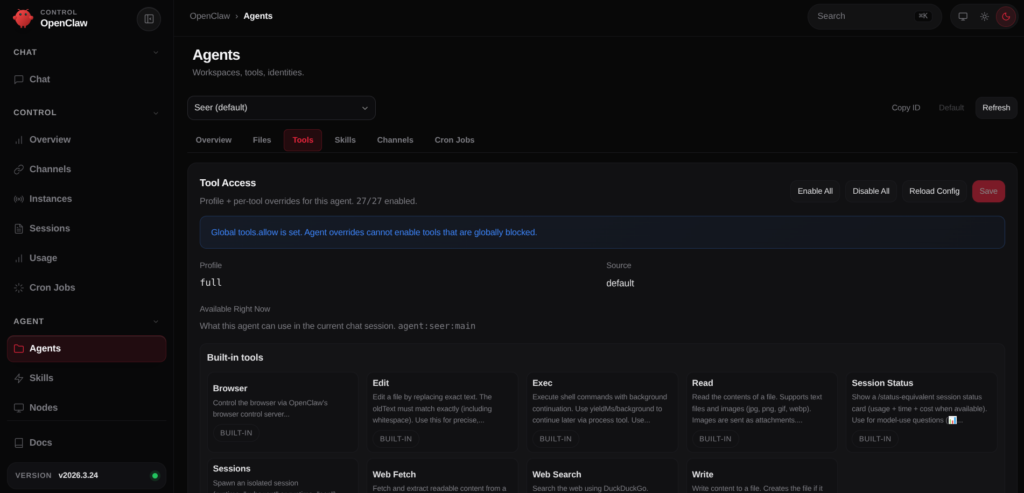
Having a fleet of specialist agents is only useful if something can coordinate them. Multiple investigative agents sitting in separate rooms with no one managing the case is not an intelligence platform. It’s just chaos. That was the problem Seer was built to solve.
The name comes from science fiction and fantasy. The Seer is the all-seeing, all-knowing entity that perceives what others cannot and directs accordingly. That fit exactly what I needed. Seer was never meant to be another investigative agent. Its job is to understand the task, know which specialist is best equipped to handle it, delegate cleanly, and manage what comes back. It is the command layer that makes the rest of the fleet function as a system rather than a collection of individual tools.
Getting it working was not easy. The first attempts to enable agent spawning failed with a permissions errors, the runtime was returning that no agents were eligible for delegation even though the configuration looked correct. Tracking that down required verifying that the agent IDs in the config matched exactly, that the gateway was reading the right config file, and that the running service had actually reloaded after the changes. Each of those had to be confirmed independently before the error cleared.
When Seer finally worked and successfully delegated a task to Whois, something clicked into place. The platform had a chain of command. One entry point, one orchestrator, and a fleet of specialists ready to receive work. That was the moment Samaritan started feeling like a real system.

AI Consulting and Support Specialist
Sec+ CySA+
I show SMBs how to leverage AI to save time, reduce costs, and increase productivity. My perspective as an independent AI Consultant was recently quoted in Bloomberg in an article discussing adversarial distillation of frontier AI models.
Let’s do a free 30 min chat via Google Meet and see if we can start turning your AI problems into solutions.