
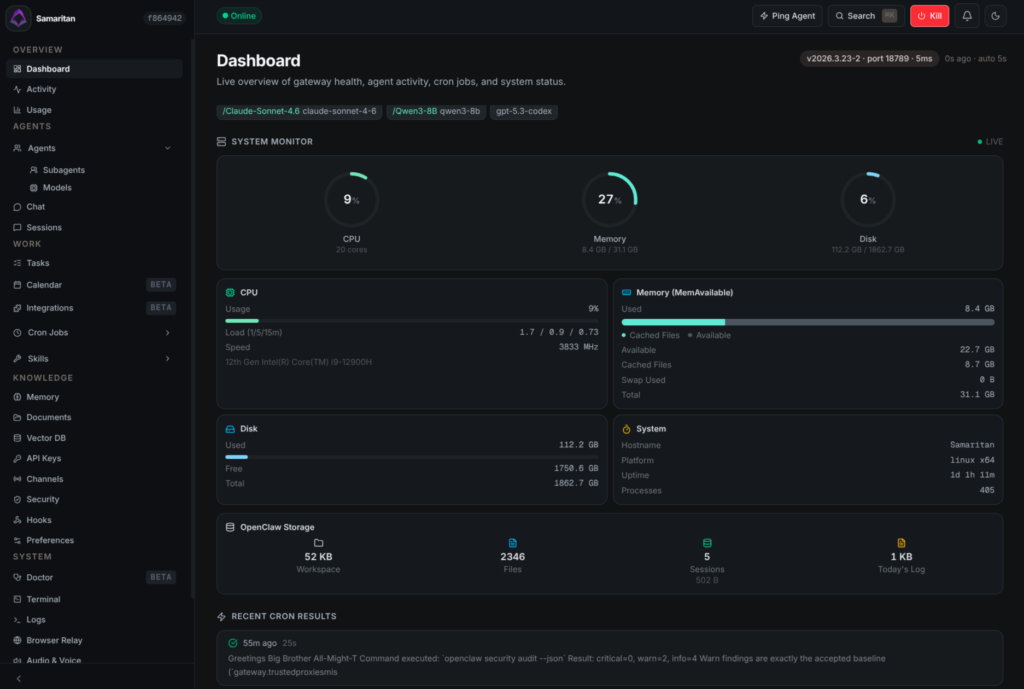
One of the hardest early lessons in building Samaritan was that not all local models are created equal, and the gap between “runs on your hardware” and “actually useful for agent work” is significant.
Know how you can tell immediately? Ask a local model to execute a tool or perform a task and watch what it does. A model with real tool execution capability does the thing. A model without it tells you how to do the thing yourself. I spent days testing models that promised tool execution and they all failed. Every one of them would respond with a helpful explanation of the command I should run instead of running it. For an autonomous OSINT platform, that is a dealbreaker.
I also ran into the hard ceiling of my current hardware. The models capable of reliable tool execution tend to be larger, and larger models need more than I could throw at them locally at the time. I was stuck between models too small to do the job and models too big to run.
What saved the build was OpenAI and Anthropic opening up OAuth access for Pro account holders. Suddenly I could connect a capable model to OpenClaw without connecting my credit card to the API billing slot machine. I had already seen too many stories of builders waking up to hundreds of dollars in unexpected API charges, and in the early days OpenClaw was burning tokens aggressively, loading everything it knew into every prompt and sending token-heavy heartbeats constantly. OAuth access gave me the model capability I needed without the financial exposure. It was the unlock that let the build continue.
It won’t be a true privacy solution until I can upgrade my hardware and run more powerful local models to prove that it can be done, but for now the proof of concept works beyond my wildest dreams

AI Consulting and Support Specialist
Sec+ CySA+
I show SMBs how to leverage AI to save time, reduce costs, and increase productivity. My perspective as an independent AI Consultant was recently quoted in Bloomberg in an article discussing adversarial distillation of frontier AI models.
Let’s do a free 30 min chat via Google Meet and see if we can start turning your AI problems into solutions.