

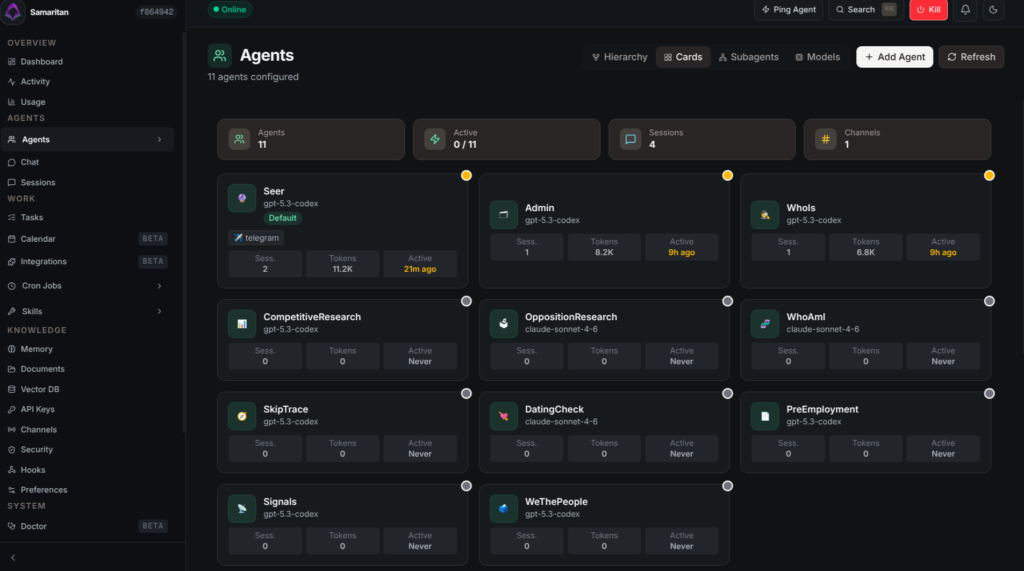
Once I had the methodology, the next question was how to actually set it up. A single general-purpose OSINT agent sounds good, but in reality it produces jumbled results. Ask it to build a personal profile and it will try to do everything at once, pulling in too many sources without depth in any of them. I decided early that specialized agents was the answer.
The idea was simple. If each agent was built with a specific scope, a defined set of Parrot OS tools, and resources relevant to that task, and clear boundaries on what it would and wouldn’t investigate, the results would be tighter and more consistent. A skip trace agent that only does skip tracing will always outperform a general agent that also does skip tracing on the side.
I started with the use cases I considered the most common and the most useful: Whois for full entity and person profiling, Skip Trace for locating current whereabouts through public records, Pre-Employment for verifying claims and surfacing job-relevant red flags, and Dating Check for personal safety vetting. Then added Political Investigator for mapping political networks, voting records, and campaign finances, and Company Investigator for tracing entity structure, officers, litigation, and regulatory exposure.
Each agent inherited a shared base methodology but overrode its own source allowlist, pivot sequence, confidence scoring weights, and output schema. They had lanes and made sure that they stayed in them.
I also had one eye on the business possibilities. If Samaritan ever runs as a service, these are the requests that will drive the most volume. Better to build them right the first time than retrofit them later.

AI Consulting and Support Specialist
Sec+ CySA+
I show SMBs how to leverage AI to save time, reduce costs, and increase productivity. My perspective as an independent AI Consultant was recently quoted in Bloomberg in an article discussing adversarial distillation of frontier AI models.
Let’s do a free 30 min chat via Google Meet and see if we can start turning your AI problems into solutions.